
Best programmatic advertising platforms in 2026: how to score them, which minimums changed (Amazon DSP), reported fees, and a 60-day pilot to prove one works.
Compare programmatic platforms online and the minimum-spend numbers stop making sense quickly. Some roundups say Amazon DSP needs a $35,000-a-month self-serve minimum, while newer 2026 sources say Amazon dropped its self-serve minimum in late 2025.
The Trade Desk’s entry point appears as “no published minimum,” about $100,000 a quarter, $50,000 or more a month, and a $1.5 million annual threshold, depending on who you ask. Platform fees are reported at 12% to 15% in some places and 15% to 20% in others, and one source cites a take rate of about 20%. The numbers disagree because many pages are stale, because managed and self-serve access are priced differently, and because most DSPs negotiate fees privately.
Best Programmatic Advertising Platforms: So this guide doesn’t try to crown a winner. It explains what a programmatic platform does, gives you an eight-criterion scorecard to compare any two platforms, lays out what the 2026 sources report on access and fees (and why they conflict), and ends with a 60-day pilot that proves which platform earns your budget.
What a Programmatic Advertising Platform Is
Best Programmatic Advertising Platforms: A programmatic advertising platforms, usually called a demand-side platform or DSP, is the software advertisers and agencies use to buy ad space through automated, real-time auctions. You set the audience, budget, creative, and goals, and the platform bids on each ad opportunity across sites, apps, video, connected TV, audio, and more. Three ways of accessing one matter more than most comparisons admit:
- Self-serve. Your team runs campaigns directly. You get control but need the skills and time to optimize.
- Managed service. The platform’s team runs campaigns for you, usually with higher minimums and fees.
- Agency seat. An agency buys on the platform on your behalf, sometimes reselling access you couldn’t get directly at your budget.
This guide focuses on buy-side platforms. Sell-side platforms used by publishers, such as Magnite or PubMatic, are a different category.
Best Programmatic Advertising Platforms; The Eight-Criterion Scorecard
Best Programmatic Advertising Platforms: Score each candidate from 1 to 5 on each criterion, then weight the criteria by what matters to you.
| # | Criterion | What to look for |
|---|---|---|
| 1 | Inventory access | Open internet, CTV, audio, digital out-of-home, and any exclusive or walled-garden supply you specifically need |
| 2 | Data and identity | First-party data options, identity solutions such as UID2 or RampID, and clean-room integrations |
| 3 | Targeting and optimization | Quality of bidding automation, and evidence for any lift claims |
| 4 | Fees and transparency | Platform fee, data fees, ad serving and verification costs, log-level data, and supply path controls |
| 5 | Measurement | Support for incrementality tests, brand lift, and integration with your attribution |
| 6 | Access model and minimums | Self-serve, managed, or agency seat, and the real spend needed to optimize |
| 7 | Support and learning curve | Account support quality, and whether your team can actually run it |
| 8 | Integrations and exit terms | CRM and analytics connections, data export, contract length |
Example Weighting by Advertiser Type
| CriterionEcommerce brandB2B companyLocal or regional business | |||
|---|---|---|---|
| Inventory access | 15 | 15 | 10 |
| Data and identity | 20 | 20 | 10 |
| Targeting and optimization | 15 | 15 | 15 |
| Fees and transparency | 15 | 15 | 15 |
| Measurement | 15 | 15 | 10 |
| Access model and minimums | 10 | 10 | 20 |
| Support and learning curve | 5 | 5 | 15 |
| Integrations and exit terms | 5 | 5 | 5 |
Adjust the weights to your situation, as long as they total 100.
The Major Platforms at a Glance
Best Programmatic Advertising Platforms: The descriptions below reflect how 2026 roundups characterize each platform. Verify current terms directly.
| Platform | Best for | Access | Reported entry point | Watch for |
|---|---|---|---|---|
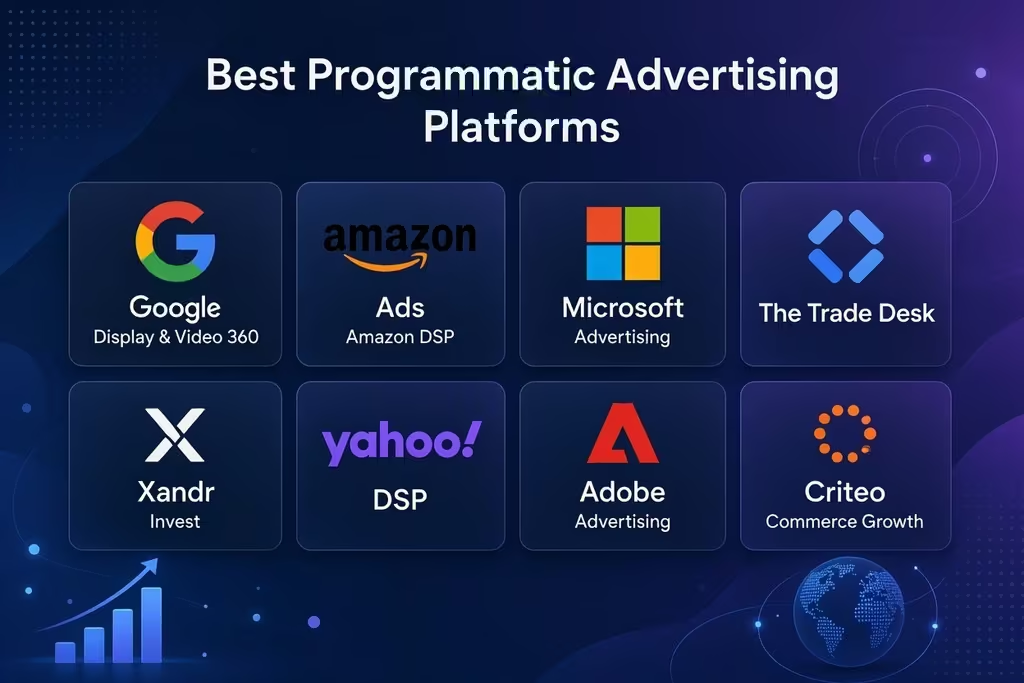
| The Trade Desk | Open-internet and CTV at enterprise scale | Historically managed, often through agencies and larger direct accounts | No public pricing; reports range widely | Can overwhelm small teams |
| Google Display & Video 360 | YouTube and Google ecosystem reach | Agency-resold or direct at larger budgets | One roundup cites $300,000 or more a year | Best value if you already live in Google’s stack |
| Amazon DSP | Retail and shopper data, Amazon-owned streaming and retail inventory | Self-service and managed | Self-service has no Amazon-imposed minimum since late 2025, per 2026 sources; managed is typically around $50,000 a month | Practical spend still needed to optimize |
| StackAdapt | Mid-market, native, and CTV | Self-serve | No minimum on paper, with about $5,000 to $10,000 a month cited as the practical starting point | Less depth outside its core strengths |
| Basis Technologies | One platform for programmatic, search, and social | Managed and self-serve tiers | Varies | Platform-led; confirm scope |
| Adform | European agencies wanting a DSP and ad server together | Hybrid | Varies | Strongest in EMEA |
| Viant | People-based and privacy-focused targeting | Platform with managed options | Not published | Confirm current capabilities |
| Simpli.fi | Local, geo-fenced, and household-level targeting | Platform with managed options | Media minimums vary | Narrower use cases |
One note on staleness: Microsoft’s DSP, Microsoft Invest, shut down on February 28, 2026, and MediaMath collapsed in 2023. If a roundup still lists either as available, the rest of its data may be out of date too.
Minimums and Fees: What Sources Report, and Why They Conflict
| Item | What you’ll see | Likely explanation |
|---|---|---|
| Amazon DSP self-serve minimum | $35,000 or more in older roundups; no Amazon-imposed minimum in 2026 sources | Amazon dropped the self-serve minimum in late 2025, and older pages weren’t updated |
| Amazon DSP managed minimum | Typically about $50,000 a month, varying by country | Managed service is priced separately |
| The Trade Desk entry | From about $100,000 a quarter to $1.5 million a year for self-serve, or no published minimum | Access is mostly managed or through agencies, and terms are negotiated |
| StackAdapt entry | No minimum on paper, about $5,000 to $10,000 a month in practice | A practical floor is set by how much data the system needs to learn |
| Platform fees | 12% to 15% in some sources, 15% to 20% in others, a take rate near 20% in one | Fees are negotiated, and “take rate” can include more than the platform fee |
| Amazon DSP fee | Reported by one outlet at about 1%, with other sources listing higher | Fees are changing quickly, so ask for current terms |
The practical point is that the real gate is no longer always the contractual minimum. It’s signal. Sources suggest that even with no formal floor, platforms need roughly $5,000 to $10,000 a month, plus enough conversions, to leave the learning phase and optimize well. Below that, results can be noisy.
Which Platform Fits Your Budget Stage
Best Programmatic Advertising Platforms: Sources disagree on exact thresholds, so treat these as rough guidance:
| Monthly programmatic budget | Realistic approach |
|---|---|
| Under about $10,000 | A self-serve platform with a low entry point, or a managed service sized for small budgets |
| About $10,000 to $50,000 | Self-serve mid-market platforms, Amazon DSP self-service if shopper data fits, or an agency seat on a larger platform |
| About $50,000 to $250,000 | Managed tiers open up, and larger DSPs become realistically accessible |
| $250,000 and above | Enterprise platforms with dedicated support, custom measurement, and negotiated fees |
A 60-Day Pilot That Proves Which Platform Earns Your Budget
Best Programmatic Advertising Platforms: Choosing from a scorecard narrows the field. A pilot decides it.
- Define one primary outcome. For example, new customers or qualified leads, not clicks.
- Limit the test to two platforms. More than that splits your budget too thin to learn.
- Match conditions. Use the same audiences, creative, flight dates, and equal budgets, large enough to leave the learning phase.
- Verify the basics in week one. Confirm tracking, placement-level reports, viewability, and brand safety settings.
- Hold changes in weeks two through four. Constant tinkering makes results unreadable.
- Measure incrementality, not just last-click. Use a geographic holdout or conversion lift test where possible, since each platform will claim credit for sales that would have happened anyway.
- Add up the full cost. Include platform fees, data, verification, and any agency fees.
- Decide using cost per incremental outcome. Set the decision rule before the test starts.
What to Ask Every Platform
- Can I get placement-level and log-level data?
- What are all the fees, and what share of my spend reaches publishers?
- How do you limit low-quality and made-for-advertising inventory?
- What evidence supports your optimization claims? Ask for methodology behind any quoted lift, such as 20% to 30%.
- What measurement partners do you support?
- What are the contract length and exit terms, and can I export my data and audiences?
Red Flags
- Fees that can’t be itemized
- No placement-level reporting
- Optimization described as a black box with no explanation
- Long lock-ins or inflated minimum commitments
- Lift claims without methodology
- Pricing pages that haven’t been updated, which can signal the information you’re using is stale
Frequently Asked Questions
- What is the best programmatic advertising platform? It depends on your goal, budget, and team. The Trade Desk, Google DV360, and Amazon DSP are the largest, StackAdapt is frequently recommended for mid-market and self-serve, and the right choice comes from scoring platforms against your own priorities and testing them.
- What’s the minimum budget for programmatic advertising? Some platforms have no contractual minimum, but sources suggest roughly $5,000 to $10,000 a month is where optimization starts working well. Managed services and enterprise platforms often require far more.
- Does Amazon DSP still have a minimum spend? According to 2026 sources, Amazon removed the Amazon-imposed minimum for self-service DSP in late 2025, while managed service typically requires around $50,000 a month. Some older roundups still show the previous figure.
- What do programmatic platforms charge? Most charge a percentage of media spend, with reported ranges from about 12% to 20%, plus possible data, ad serving, and verification fees. Fees are usually negotiated, so request an itemized quote.
- Should I use self-serve or managed? Self-serve suits teams with in-house expertise who want control. Managed service suits teams that lack that expertise or time, usually at higher cost.